Education is one of the most significant aspects of human life. It is not merely an indicator of individual progress but the cornerstone that determines the dynamics and cohesion of the social fabric. It stands as the central pillar of productive life, transforming human potential into a country’s most valuable resource.
In this context, the Municipality plays a decisive role, as investing in knowledge at the local level is the “key” to economic growth, social equality, and the upgrading of its citizens’ quality of life.
The 2021 census data provides a clear picture of how the population is distributed across different educational levels.
Municipal Population by Educational Level
If we look at the educational level of the population of the Municipality of Patras for the year 2021, the following observations emerge:
Bar chart of population by education level (Municipality of Patras, 2021)
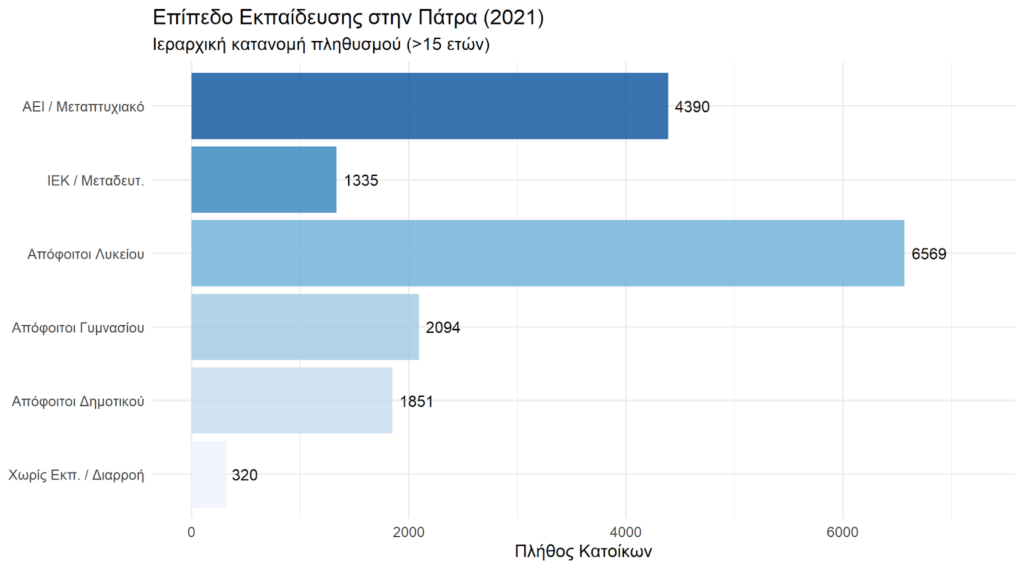
Table: Population Percentage by Education Level (2021)
| Education Level | Percentage | Group Description |
| Medium (High School/IEK) | 60.4% | Graduates of secondary and technical education. |
| High (University/Postgraduate) | 26.5% | Holders of higher education degrees and postgraduate titles. |
| Low (Basic Education) | 13.1% | Individuals with a primary school certificate or without completed basic education. |
The majority of the population of the Municipality of Patras (2021) holds a secondary education level (High School/IEK), representing 60.4%. This percentage underscores the importance of this educational level as the most widespread and fundamental for the majority of the workforce.
On the other hand, the population with high education (University/Postgraduate) constitutes a significant, yet smaller, portion of the total at 26.5%. This figure highlights the existence of a specialized segment of the population, which is vital for innovation and competitiveness.
Finally, 13.1% of the population remains at a low educational level (Basic Education), highlighting the need for targeted social and educational policies. Investing in lifelong learning programs and basic education, particularly at the local level, can help reduce inequalities and integrate this segment of the population into the labor market and social life.
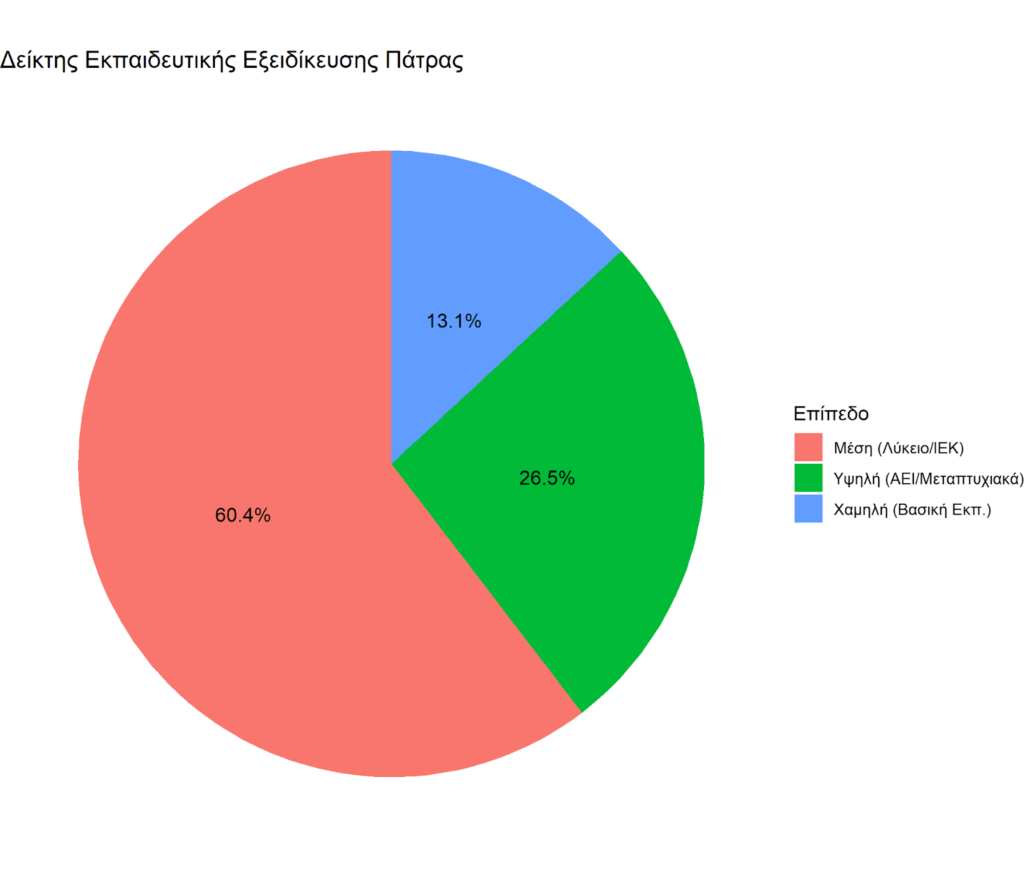
In summary, the Municipality of Patras is characterized by a balanced educational ecosystem, where the majority of the population possesses at least a secondary education, while a very strong segment (more than 1 in 4) belongs to the high scientific tier.
The data shows:
More than 1 in 4 residents in 2021 belonged to the high scientific tier.
A minority of the population (13.1%) holds basic/low education.
The majority of the population (60.4%) holds medium education.
The data underscores the progress made, highlighting that access to higher education is steadily expanding, while the percentage of the population lacking this opportunity is comparatively small with strong prospects for further reduction in the coming years.
You can find the analyzed datasets at the following address: 🔗 https://catalog.data.patras.gr/dataset/kinoniko_kai_ekpaideytiko_profil_2021
For detailed datasets, additional charts, and the ability to download and reuse the data, you can visit the official Open Data portal of the Municipality of Patras at: 🔗 https://catalog.data.patras.gr/dataset/