Social Structure, Family, and Daily Commute (2021 Census)
A city’s image is not captured solely by the number of its inhabitants. It is reflected in how its people live: whether they live alone or with family, at what age they form bonds, and how they move through their daily lives. The 2021 Census data provides us with a clear picture of the social and family structure of Patras.
Age and Marital Status: A City in Different Life Stages
If we examine the marital status of the population by age group, an image emerges that aligns perfectly with the city’s character.
- Ages 0–29 The category of single individuals clearly dominates. Patras is a city with a strong presence of youth and students, which is directly reflected in the data.
- Ages 30–59 The center of gravity shifts toward married individuals and those in civil partnerships. These are the most productive ages, where family life plays a leading role.
- Ages 75 and Over A strong presence of widowed individuals appears, a fact linked to the aging of the population that highlights the need for social care and support.
What is the picture if we look only at the adult population?
If we exclude children under 15 and focus on adults, the city’s social structure becomes even clearer:
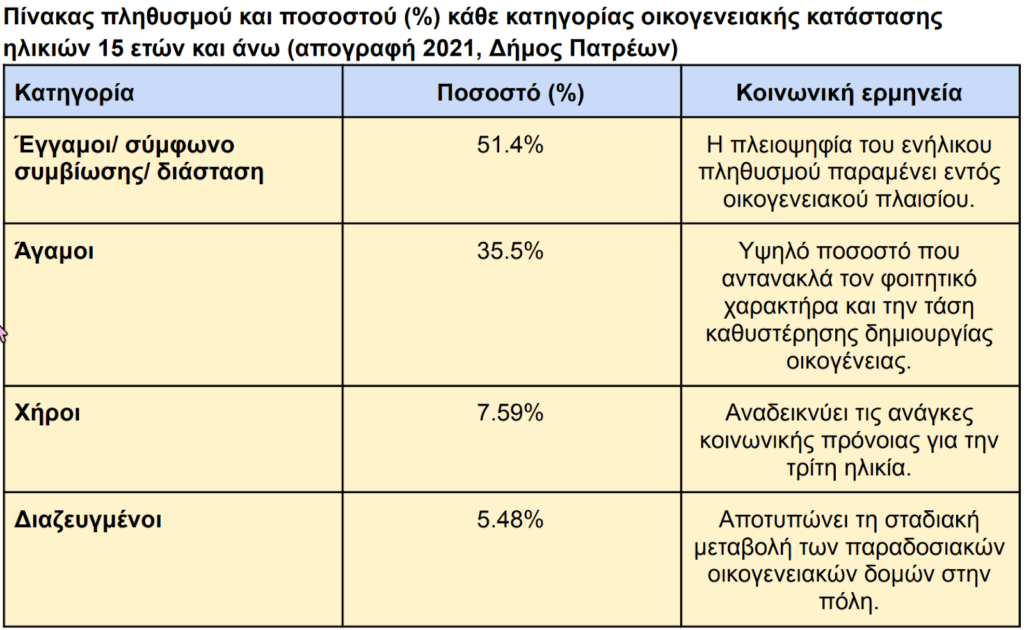
5.5% are divorced, showing the gradual change in traditional family forms
51.4% of residents are married or in a civil partnership.
35.5% are single—a high percentage linked to:
- The city’s character as a student hub.
- The trend of delaying starting a family.
7.6% are widowed, highlighting the needs of the elderly.
How many people make up a family in Patras?
One of the most interesting pieces of data from the census concerns the size of family nuclei. It is important to note that family nuclei are not the same as households. A person living alone constitutes a household, but not a family nucleus.
In Patras:
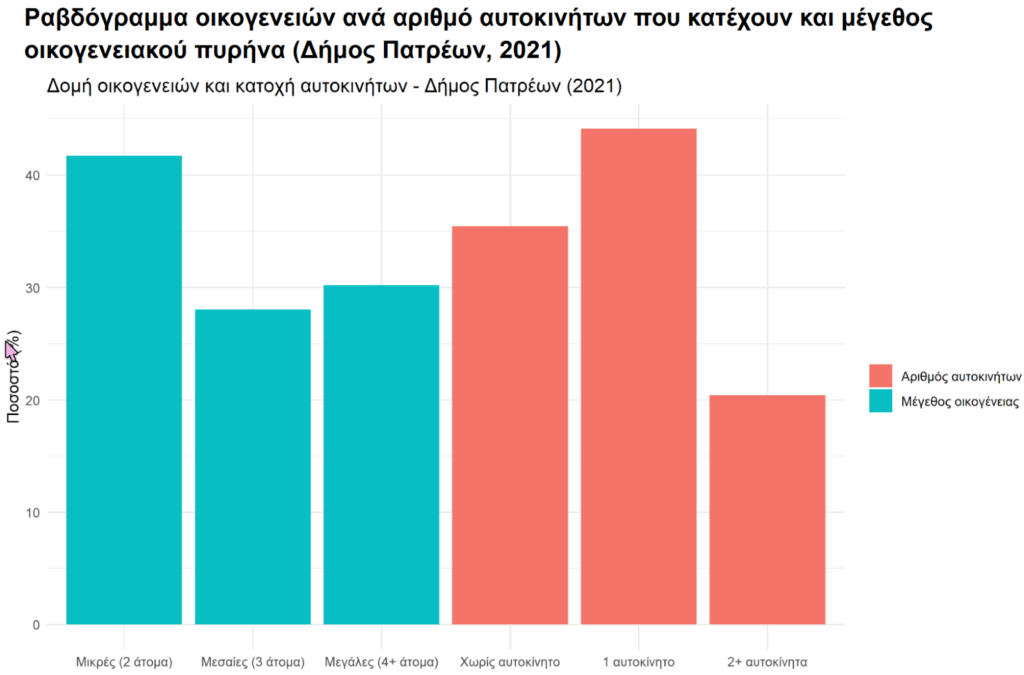
- 41.7% of families consist of two members.
- 28.1% have three members.
- 30.2% consist of four or more people.
Despite demographic challenges, a significant percentage of families remain large, a fact showing that family life continues to play a central role in the city.
Car and Everyday Life
Transportation is a core element of quality of life. The data shows that Patras exhibits a variety of commuting methods.
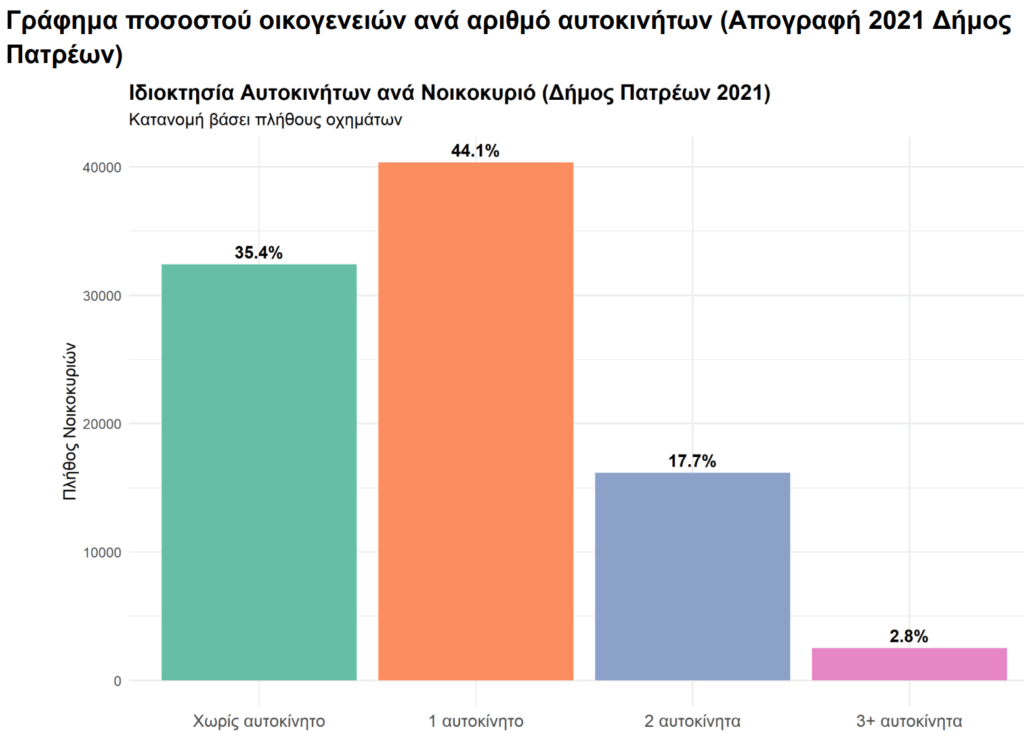
- 44.1% of households own one car.
- 17.7% own two cars.
- 2.8% own three or more.
- 35.4% do not own any private car.
The high percentage of households without a car is linked to:
- The urban character of the city center.
- The use of public transportation.
- Economic constraints
Family and Commuting: How they are linked
By combining family size with car ownership, an interesting picture emerges:
- Two-member families are the most common.
- Large families (4+) make up about 30%.
- However, only 20.5% of households own two or more cars.
This indicates that:
- Many large families operate with only one vehicle.
- Or they rely on alternative modes of transport.
- Mobility is an issue directly linked to the social structure.
The data reveals a Patras characterized by:
- A strong youth presence
- An active family core
- Diverse needs based on age and lifestyle
You can find the analyzed datasets at the following address:
🔗 https://catalog.data.patras.gr/dataset/nikokiria_kai_diabiosi
For detailed datasets, additional charts, and the ability to download and reuse the data, you can visit the official Open Data portal of the Municipality of Patras at: 🔗 https://catalog.data.patras.gr/dataset/