Agricultural activity has long served as the cohesive link between a region’s historical heritage and its economic development. It goes beyond mere production of goods, functioning as a living system that shapes the landscape, social organization, and resilience of the local economy. Through proper land management, the primary sector becomes a stable axis that transforms natural resources and human effort into wealth and social well-being.
Within this context, the five Municipal Units that make up the Municipality of Patras exhibit a unique dynamic, where the balance between family-run farming and modern labor demands is key to understanding the area’s productive profile and enhancing residents’ quality of life.
The 2020 Agricultural Holdings Census data provide a clear picture of the structure of farms across the Municipal Units of Patras and the workforce engaged in them.
Geographical Distribution and Number of Agricultural Holdings
The Municipal Unit of Patras stands out significantly, hosting approximately 3,500 agricultural holdings—nearly three times the number of the second-ranking unit—highlighting the vital economic role of agriculture within the city’s urban fabric.
Only the Municipal Units of Patras and Rio exceed 1,000 holdings.
Rio, with around 1,100 holdings, maintains a slight lead over Messatida, which closely follows with 1,000 holdings.
At the lower end of the spectrum are Vrachneika and Paralia, with approximately 700 and 400 holdings respectively, underscoring the variations in agricultural activity across the different areas of the
Bar Chart: Distribution of Agricultural Holdings by Category of Employed Population per Municipal Unit (2020)
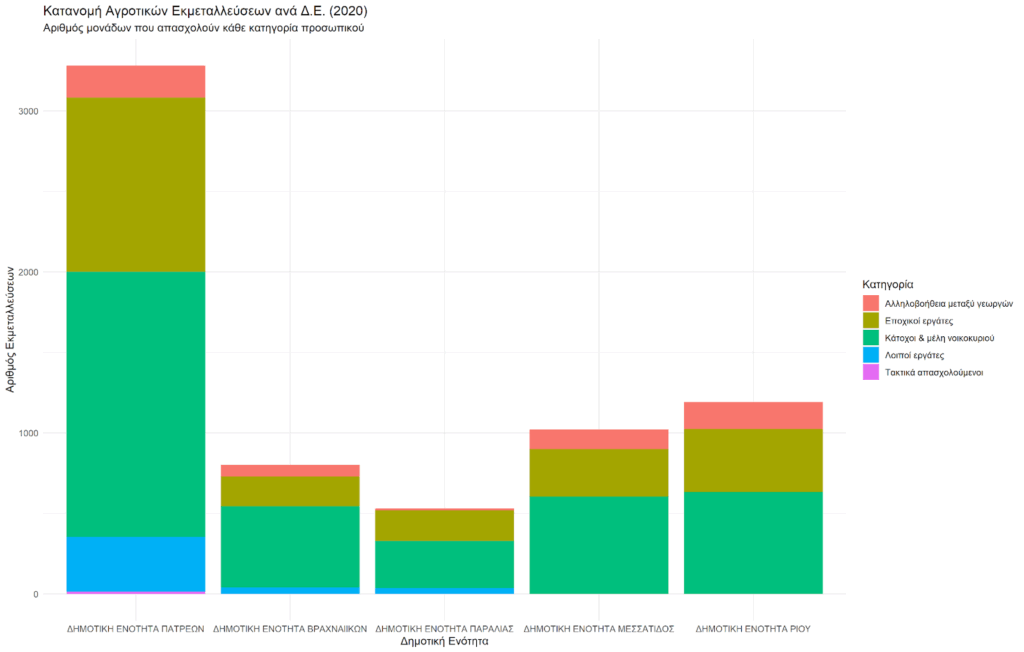
Geographical Distribution and Production Profile
Municipal Unit of Patras:
- It is the only unit where seasonal workers outnumber the owners.
- It concentrates almost all regularly employed workers, indicating intensive farms that rely on external labor.
- The strong mutual assistance reflects active informal social networks despite the urban character.
Municipal Unit of Messatida:
- It shows a distinct profile where seasonal workers exceed household members, suggesting crops that require large-scale mobilization of labor.
Municipal Units of Rio and Vrachnaiika:
- They maintain a more traditional profile, with owners and their families being the largest group.
- Agriculture here relies more on personal labor and less on external workers.
- As in Patras, mutual assistance is strong, indicating robust social bonds.
Bar Chart: Distribution of the Workforce in Agricultural Holdings by Category of Workers (Municipal Units, 2020)
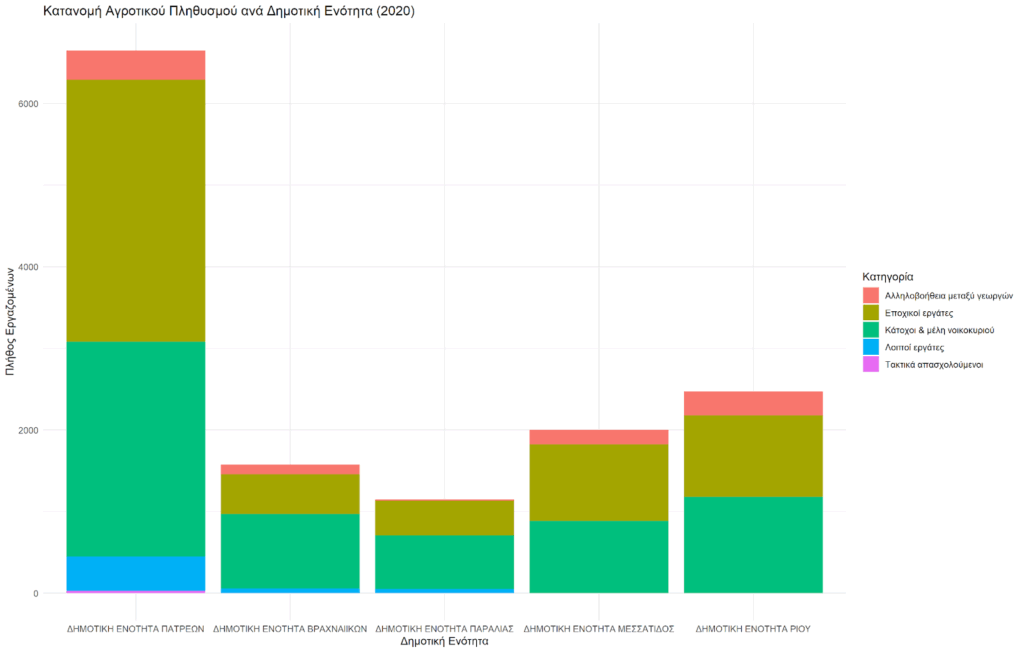
Patras Municipal Unit:
- The only municipal unit where seasonal workers (~48.2%) outnumber the owners.
- Nearly all regularly employed external workers are concentrated here (small but notable percentage), indicating intensive agricultural holdings relying on external labor.
- Mutual assistance (~6.3%) highlights active informal social networks despite the urban context.
Messatida Municipal Unit:
- Seasonal workers (~46.3%) slightly exceed household members (~44.2%), suggesting crops that require large-scale mobilization of labor.
Rio and Vrachnaiika
- Exhibit a more traditional profile, with owners and household members as the majority (~67.1% in Rio, ~57.7% in Vrachnaiika).
- Agriculture here depends more on family labor and less on external workers; seasonal workers are secondary (~30.9% in Rio, ~31.1% in Vrachnaiika).
- Mutual assistance is significant in Rio (~11.9%), reflecting strong traditional social ties among farmers.
Bar chart of the percentage distribution of the working population by Municipal Unit (2020)
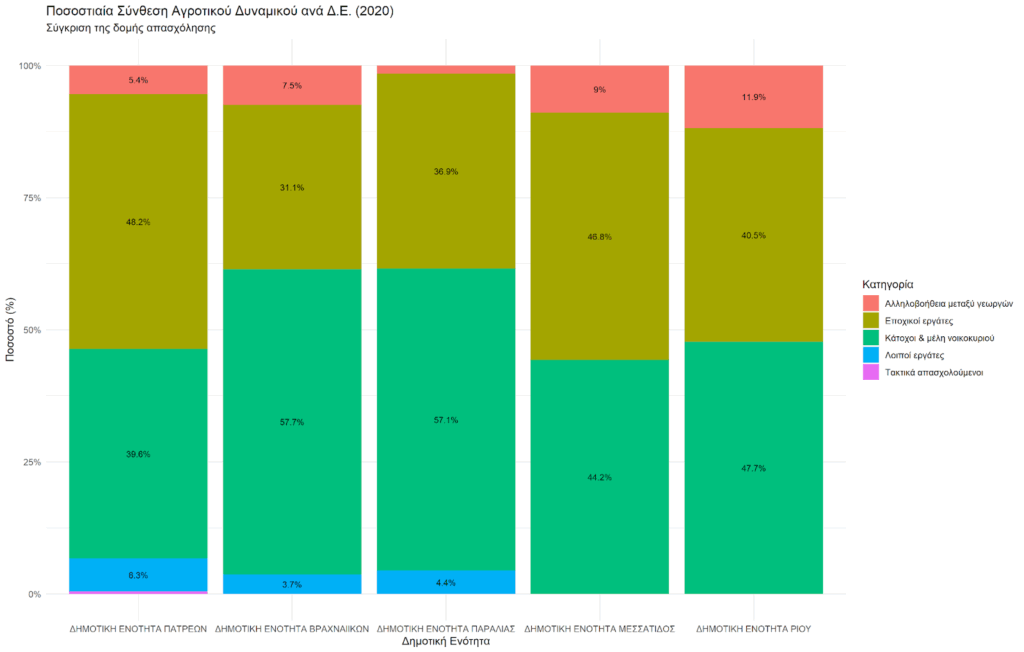
Labor Intensity by Municipal Unit
The analysis of the Average Number of Workdays per Person (Workdays / Employed Population) Provides a New Perspective, Highlighting Actual Labor Intensity:
Brachnaika Municipal Unit – The Most Intensive Area:
Although it ranks fourth in terms of employed population, it comes first in labor intensity, with 32.2 workdays per person annually.
This suggests that agricultural activity here is more systematic and less “amateur.”
Patras Municipal Unit – High Volume, Low Intensity:
It accumulates a huge volume of 138,338 workdays but has the lowest average (just 20.8 days per person).
This confirms that in the central urban area, agriculture involves many people, but for very short periods (likely only a few harvest days).
Paralia and Rio Municipal Units – Balanced Levels:
They operate at medium, balanced intensity levels (28.2 and 25.3 days per person, respectively), indicating a stable agricultural presence.
Messatidos Municipal Unit – Similar Levels to Rio:
It shows an average of 25.2 days per person, close to Rio’s level.
Ratio of Agricultural Holdings to Workers
Municipal Unit (M.U.) of Patras (2.03): This ratio confirms the classic model of small peri-urban holdings, where the owner is supported by one additional person (typically a seasonal helper).
M.U. of Messatida (1.96) and M.U. of Vrachneika (1.97): The model (a typical productive and organizational pattern of agricultural holdings) nears the absolute “2”. This indicates a strictly family-based structure, where labor is shared almost exclusively between two members of the household.
M.U. of Rio (2.30) and M.U. of Paralia (2.17): A slightly increased ratio is observed. This suggests either the existence of holdings with higher labor requirements or more active participation from additional family members in production.
Ratio of Agricultural Holdings to Workers (M.U., 2020)
| Municipal Unit (M.U.) | Holding-to-Worker Ratio |
| M.U. of Patras | 2.03 |
| M.U. of Rio | 2.30 |
| M.U. of Messatida | 1.96 |
| M.U. of Vrachneika | 1.97 |
| M.U. of Paralia | 2.17 |
You can find the datasets analyzed at the following address: https://catalog.data.patras.gr/dataset/protogenis_tomeas_kai_agrotiki_drastiriotita
For detailed datasets, additional charts, and the ability to download and reuse the data, you can visit the official Open Data portal of the Municipality of Patras at: https://catalog.data.patras.gr/dataset/